AMIR Heydari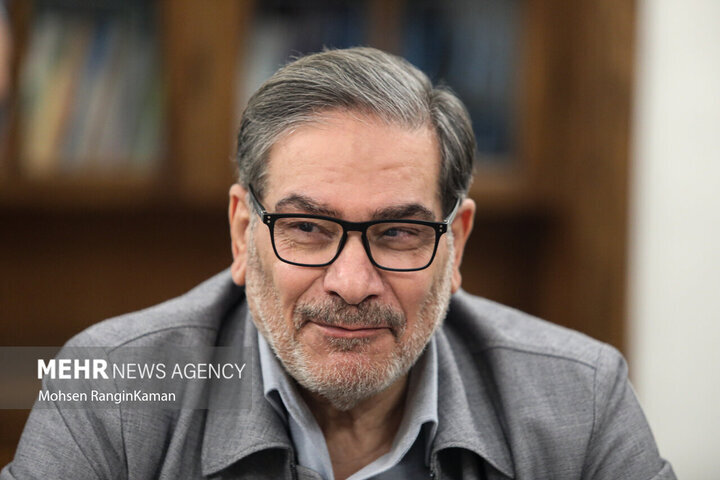
In an exclusive interview for Al Mayadeen, Shamkhani, dressed in military attire and said, “There is no reason to move the stored material out of Iran,” in response to proposals made to Iran as part of the nuclear negotiations and suggesting Russia as an option to this end. He emphasized that Iran’s nuclear program is “peaceful and within local capabilities,” adding that “60% enrichment can be reduced to 20% if they are concerned, but they must offer something in return.”
The senior advisor stressed that Iran’s enriched uranium at 60% is intended primarily “to counter enemy conspiracies against us first, and secondly to prepare for negotiations and dialogue.”
On the question of nuclear weapons, he said, “The West perhaps does not understand, or does not want to understand, what we say, that producing or possessing weapons is forbidden by a religious decree,” emphasizing that this is non-negotiable and stems from the vision of a religious authority, the Leader of the Revolution, Ayatollah Seyyed Ali Khamenei.
Reiterating Iran’s long-standing position, Shamkhani listed the “three nos” from previous negotiation rounds: “Iran does not seek nuclear weapons, will not seek a nuclear weapon, and will never stockpile nuclear weapons, but the other side must pay a price in return for this.”
He also revealed a key point about Iran’s stockpile, saying, “The quantity of enriched uranium remains unknown, because part of the stockpile is under rubble, and there is no initiative yet to extract it, as it is extremely dangerous.” That is why, Shamkhani said, negotiations with the International Atomic Energy Agency (IAEA) are ongoing “to estimate the quantity while maintaining security and avoiding risk.”
On talks with the United States, the Defense Council senior official stated that Iran “has repeatedly confirmed and demonstrated its readiness for practical negotiations with the United States solely, and not with anyone else,” criticizing, in this context, Europe’s role as it has “practically proven that it cannot do anything, after US President Donald Trump withdrew from the nuclear deal in 2018, and also during negotiations before last June’s war.”
“Even Trump did not allow them to intervene in these matters,” Shamkhani asserted to Al Mayadeen.
He further clarified, “The negotiations are limited to the United States and to the nuclear file, over which an agreement can be reached.”
On the conditions for talks, Shamkhani asserted that they should be carried out “away from atmospheres of threats and coercion tools” and that both sides should “sit from an equal standing at the negotiating table, start bilateral negotiations based on reaching mutual understanding, and avoid illogical and unreasonable demands.”
“Only then would reaching an agreement be possible,” the top Iranian military official affirmed.
On potential meetings between Iranian and US officials in Turkey, he said, “If negotiations start under the conditions I mentioned, with the two basic requirements of staying away from threats and avoiding illogical orders, of course, there is the possibility for direct and indirect meetings with the American side.”
On direct negotiations, Shamkhani explained, “They will be preceded by indirect negotiations. If there is an understanding and if it forms quickly, the situation can shift to direct negotiations,” reiterating that any such talks will be limited to the nuclear file.
“One of the conditions of the negotiations is to limit them to the nuclear dossier,” he asserted.
The senior member of the Supreme National Defense Council also addressed growing threats of war against Iran, wearing his military uniform as a practical signal of readiness. He said, “War is not just exchanging fire or the whizz of cannons. We are actually living in warlike conditions, but we are prepared for any circumstances that may arise.”
He clarified that this military readiness “does not mean provoking war, but we are facing an unjust war and threats imposed on us by our enemies, who are preparing for this war with all their capabilities.”
Addressing the true objective behind the threats of war on Iran, Shamkhani said, “The enemies are seeking to swallow Iran,” adding that “swallowing Iran while the Islamic Republic exists is impossible. Iran is a morsel that will get stuck in their throats; they will never be able to swallow it.”
He noted that adversaries “have still not learned from their previous experiences,” pointing out that “over the past four decades, they have taken numerous measures against the Islamic Republic of Iran with the aim of swallowing Iran, to no avail.”
Shamkhani told Al Mayadeen, “I hope that in this experience as well they realize this reality and understand that Iran is not swallowable. Before they spend their money and threaten the security of the region, they should be deterred from this kind of behavior.”
When asked whether war is inevitable or if political exits remain possible, the Iranian admiral responded, “In our military capacity, we must assume that war is inevitable, without a doubt.” However, he added that “within political realities, there is still ample time to invest opportunities in the right direction.”
DID