AMIR Heydari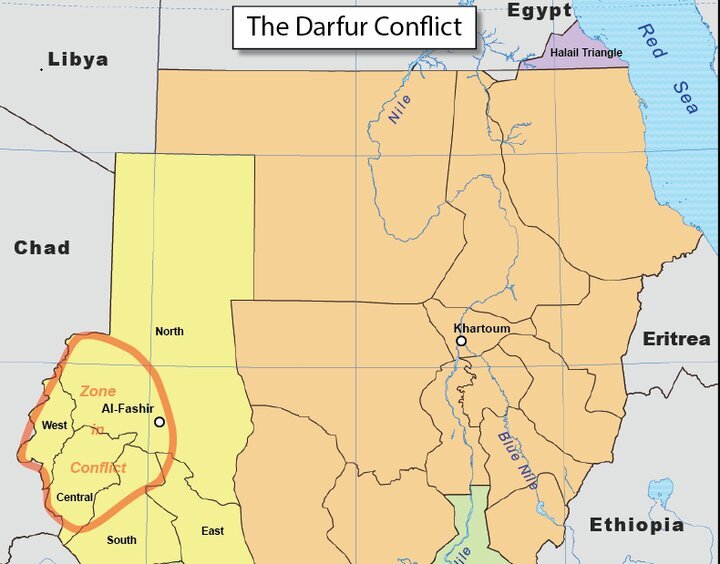
Sudan is one of the largest countries in Africa, as large as over 1.86 million square kilometers, acting as a bridge between the north and south of the continent. The country is located in eastern Africa. It is bounded on the north with Egypt and Liby, on the west with Chad and the Central African Republic, and on the south with Ethiopia and Uganda, and on the east with the Red Sea.
Sudan’s diverse geography, from the arid deserts of the north to the fertile plains of the center and the mountains of the west, makes it a complex and multifaceted land. The Nile River, with its two branches, the Blue and White, is the backbone of life in the country, where a large part of Sudan’s 48 million people live there. Despite this important geographical location, Sudan has been plagued by ethnic crises, civil war and structural poverty for decades. One of the epicenters of this crisis is the Darfur region in the west of the country, a land rich in resources but grappled with the conflict and instability.
The city of Al-Fashir, the capital of North Darfur state, has become a symbol of the conflict in recent years. The fall of Al-Fashir city in October 2025 by the Rapid Support Forces (RSF) turned the tide of the war in western Sudan and raised concerns about the country’s disintegration. The fall was accompanied by war crimes and marked one of the darkest chapters in Sudan’s history. This report examines the geographical situation of Sudan, Darfur and Al-Fashir city, and analyzes their role in economic, military, political and humanitarian dimensions.
Geography of Sudan: An Unstable Bridge between Africa and Arab World
Geographically, Sudan is divided into three main parts:
– The desert north with the Nubian Desert and the arid regions of Biar
– Fertile center around the Nile River and the plains of Gezira
– The south and southwest, which have a warmer climate and denser vegetation.
The country covers an area of over 1.86 million square kilometers and has an estimated population of about 48 million. The population density is low (25 people per square kilometer) and the annual population growth rate is reported to be about 2.5%. About two-thirds of the people live in rural areas and their livelihoods revolve around agriculture and animal husbandry.
Sudan’s economy was based on oil exports before the secession of the south, but since then, gold, cotton, livestock, and agricultural products have replaced the main sources of income. However, civil war and international sanctions have reduced the country’s gross domestic production (GDP) to about $30 billion.
From the geopolitical point of view, Sudan’s location is strategic: long borders with seven countries, direct access to the Red Sea, and its role as a gateway between North Africa and the east of the continent. This position has made the country constantly vulnerable to the influence of external actors. To the east, the Red Sea is a link to the Middle East, and to the west, the border with Chad and Libya is a route for smuggling and troop movements.
The clash between the Sudanese Armed Forces (SAF) and the Rapid Support Forces (RSF), which began in April 2023, has torn the country’s political and geographical structure apart. The east of the country and the port of Port Sudan are now under the control of the army, while the west, especially Darfur, is under the influence of the RSF. The war has created more than 10 million internally displaced persons and 2.3 million refugees in neighboring countries, and has brought famine to a crisis in several states.
Darfur: Sudan’s Western Heartland, a Land of Resources and Conflict
Darfur is one of the largest states in Sudan, covering an area of about 510,000 square kilometers, or nearly one-fifth of the country. It borders Chad to the west, Libya to the north, Kordofan to the east, and the Central African Republic to the south. Darfur is a mixture of desert and highlands, with an average elevation of about 700 meters above sea level. The annual rainfall ranges from 200 to 600 millimeters, but frequent droughts and desertification have limited natural resources.
Darfur’s population is estimated at between 8 and 10 million, about one-fifth of Sudan’s population. This diverse population is made up of more than 80 ethnic groups. More than 70 percent of the population is engaged in agriculture and livestock farming, and about 20 percent of the country’s livestock is kept in the region.
Darfur is rich in natural resources. Gold mines in the region provide about 30 percent of Sudan’s gold output. In addition to gold, deposits of chromium, copper, and even traces of uranium have been identified in Darfur. Despite these potentials, war and insecurity have hindered economic development, making Darfur one of the poorest regions in the country.
Darfur’s long borders with Chad and Libya have made it a vital route for formal and informal trade. They are also a route for arms smuggling and migrants. Since 2003, Darfur has been the scene of bloody ethnic conflicts that, according to the United Nations, have left more than 300,000 people dead and millions displaced. In the current conflict, the RSF, made up of former Janjaweed militias, controls most of Darfur’s states. Only the city of Al-Fashir, in northern Darfur, remained in the hands of the army for a long time, and that too recently fell in unprecedented carnage.
Al-Fashir: The capital of North Darfur, a crossroads of crisis
Al-Fashir, the capital of North Darfur state, is located 800 kilometers west of Khartoum. The city, with an altitude of about 700 meters above sea level, is located on the main roads between Darfur, Chad, and Libya, and is considered a key point geographically. Al-Fashir has a long history. It was the capital of the Kingdom of Darfur from the 17th to 19th centuries, and Sultan Ali Dinar ruled the region from there. The Sultan Ali Dinar Palace and Museum, which was inscribed on the United Nations Educational, Scientific and Cultural Organization (UNESCO) list in 2023, is a cultural symbol of the city; although it has been seriously damaged in the recent wars.
Before the recent civil war, Al-Fashir had a population of around 500,000, but a wave of refugees from other parts of Darfur has pushed its population to over a million. A large portion of these people live in the Zamzam and Naifash camps. Al-Fashir’s residents are a mix of different ethnicities. The local economy is based on livestock farming and the gold trade, and Al-Fashir’s camel market is one of the largest animal markets in western Sudan.
Militarily, Al-Fashir was the last major base of the Sudanese Army (6th Infantry Division) in the west of the country before its fall. The long siege of the city from 2024 to October 2025 led to famine and a severe humanitarian crisis. Al-Fashir’s fall ultimately gave the RSF full control of Darfur, opening the way for the RSF to expand its influence into Kordofan.
Dimensions of importance of Al-Fashir and Darfur
- Economic importance: Darfur and Al-Fashir play a key role in Sudan’s economy in terms of natural resources, agriculture, and livestock. Darfur’s gold mines provide a major share of the country’s exports, and the region’s livestock markets are vital for trade with Egypt and Libya. However, the civil war has led to the collapse of production and trade networks. Estimates suggest that about 20 percent of Sudan’s livestock have been lost during the war.
- Military and strategic importance: Al-Fashir is in a position that gives it a logistical advantage. The city is at the crossroads of roads leading to Chad, Libya, Kordofan, and eastern Sudan. Control of al-Fashir means control of supply routes and transport lines to the west of the country. With its fall, the army lost a large part of its defensive depth in Darfur, and RSF forces gained easier access to the center of the country.
- Political and humanitarian significance: The fall of Al-Fashir was not only a military defeat but also a symbolic blow to the central government. The event has increased the risk of Sudan’s disintegration and has paved the way for the emergence of a “parallel state” in the West. In humanitarian terms, a catastrophe is unfolding; more than a million people are living in a state of emergency, and famine and malnutrition are spreading rapidly. Reports indicate an increase in ethnic clashes between Arab and non-Arab groups, which have caused heavy casualties.
Regional implications
The RSF’s takeover of Darfur has also alarmed neighboring countries. Egypt sees Fashir’s fall as a threat to the security of its southern borders. Chad and Libya are facing a new wave of refugees and arms trafficking, and the United Arab Emirates, one of RSF’s backers, has expanded its influence in western Sudan. International experts have warned that the continuation of this trend could turn Sudan into a collection of unstable states.
Conclusion
Darfur and Al-Fashir are symbols of Sudan’s identity and structural crisis. With an area of one-fifth of the country and rich in natural resources, this region could have been a driving force beind the growth and stability, but war has turned it into one of Africa’s greatest humanitarian crises. The fall of Al-Fashir showed that Sudan’s crisis is no longer merely domestic, but has regional and even international implications. Inaction by the international community could pave the way for the country’s complete collapse. Sudan’s future depends on domestic will to negotiate and external support for reconstruction. Without it, the Darfur war could mark the beginning of the collapse of Africa’s second-largest country, a catastrophe whose effects will extend beyond the Nile Valley and into the heart of West Africa.
DID