AMIR Heydari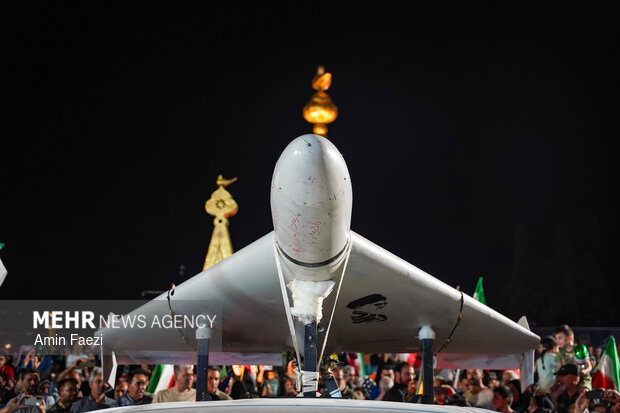
South Korea’s Defense Ministry officially announcing the development of a long-range kamikaze drone to be built based on the American “Lucas” model is highly significant news. The Yonhap News Agency has emphasized that the American Lucas drone was developed through reverse engineering of the Iranian Shahed-136 drone. This means that South Korea is now moving along a path whose starting point traces back to an indigenous Iranian technology.
This is not the first time Western media have acknowledged such a reality. About four months ago, the US-based National Interest published a detailed report on the striking resemblance between the Lucas drone and the Shahed-136, explicitly stating that this American drone is effectively a reverse-engineered version of the Iranian model. Now, with South Korea entering the same path, one can say that what was once considered merely an indigenous Iranian achievement has become a model for developing a new generation of low-cost drones in advanced militaries.
This development is not merely a technical success; rather, it signifies a shift in the standing of Iran’s defense technology within global equations. Over the past decades, one of the main axes of the media war against Iran was promoting the notion that a country under sanctions, isolated and deprived of Western technologies, is incapable of producing advanced equipment. In this narrative, sanctions were supposed to halt Iran’s engine of progress and turn the country into a permanent consumer of foreign technology.
But the experience of the past four decades has shown a different path. Instead of waiting for restrictions to be lifted, Iran focused on a capacity that no sanction could block: human capital, indigenous knowledge, and self-belief. This shift in approach gradually led to the formation of thousands of knowledge-based companies, research centers, and technological complexes, producing competitive products in various fields from nanotechnology and medicine to defense industries.
Iran’s drone industry is one of the clearest examples of this path. Contrary to the common perception that seeks military superiority only in ultra-expensive equipment and complex systems, Iran chose a different approach: designing systems that are simple, low-cost, mass-producible, and at the same time effective. The Shahed-136 embodies this very philosophy—a drone that may not appear to be the most complex system in the world, yet by relying on intelligent design and low cost, managed to change the rules of the battlefield.
In today’s world, the value of a technology is not tied solely to its complexity; rather, it depends on its degree of impact, mass-producibility, and cost-to-efficiency ratio. It is precisely for this reason that many of the world’s militaries are now moving toward developing low-cost kamikaze drones. When a technology can deliver the same operational effect at a far lower cost, it naturally becomes a model.
The significance of the South Korean news lies exactly at this point. If previously the United States was accused of copying the Shahed-136, now one of Washington’s most important allies is following the same model. This demonstrates that the Shahed is no longer merely an Iranian product, but has become part of the global trend of transformation in combat technologies.
Of course, the core issue extends beyond a single drone. What has drawn attention today is the result of a long-term strategy—a strategy founded on self-belief. Self-belief in Iran has never been merely a political slogan. Its real meaning is trusting internal capacity when access to foreign technology is blocked. While this approach may seem difficult and costly in the short term, in the long term it can transform a country from a consumer of technology into a producer and even a reference point for technology.
The Shahed-136 is precisely the product of such a mindset. This drone took shape not under normal conditions, but during the toughest era of sanctions, restrictions, and pressure. Perhaps if the path for importing equipment and technology had been completely open, the motivation to develop such a system would never have arisen. But the restrictions, contrary to the intentions of the sanctions’ architects, became an opportunity for internal capacities to flourish.
More importantly, today this reality is no longer expressed solely by Iranian media. When American media speak of the Shahed being reverse-engineered and Korean media repeat the same narrative, this is an indirect acknowledgment of Iranian technology’s standing. In the lexicon of military competition, no country copies valueless technology. Reverse engineering is itself a sign of a technology’s operational value and effectiveness.
From this perspective, the Shahed-136 should be seen as a symbol of a larger transformation—a shift in Iran’s position within the technology production chain. A country that for years was portrayed solely as a technology importer has now, in certain fields, reached a point where its products inspire the design of new systems in other nations.
Of course, this success also creates a new responsibility. As important as developing technology is, narrating it correctly is equally essential. If scientific and defense achievements are not properly presented, the narrative field is left to those who attempt to portray these successes as minor, accidental, or insignificant—while the reality is something else. From The National Interest to Yonhap, the evidence shows that Iranian technology is no longer merely a domestic matter; it has become part of the global trend of transformation in the drone domain.
The story of the Shahed-136 is ultimately not the story of a drone; it is the story of a nation that, under the toughest conditions, instead of waiting for external relief, relied on its own internal capabilities. If today an Iranian technology has become a design model in advanced militaries, this is, above all, the result of investing in knowledge, creativity, and trust in internal capacities—a path that has taken Iran from “limitation” to “benchmark.”
MNA